Reference installation: file walkthrough
The normal-game reference is installs/deluxe_dnk, Personal Companion retail 3.42. Other Worlds has its own reference at installs/other_worlds_download.
The initial first-run snapshot had 78 files, totalling 1,085,643 bytes, after its first run. Later playtesting has added/changed runtime state; the decoded current saves are in the resource browser. The original installer produced 73 files: first launch converted fourteen JPEGs to VGA files, moved resources into subdirectories and created five runtime files. All remaining original files are unchanged after accounting for those directory moves. The file inventory records the inspected paths, sizes, hashes, roles and changes from the original extraction.
Programs and the launch sequence
| File | Role |
|---|---|
CORNCOB.BAT |
The intended entry point. Runs the menu, then alternates between the flight engine and returning menu. Passes up to nine command-line arguments through to the menu. |
MOAG.EXE |
Menu/front-end program: title launch, duty roster, training setup, theatre selection, pilot records, settings, music and preparation of the next flight. Its embedded version is 3.42. |
3.EXE |
The flight/on-foot simulation, software renderer, input, weapons, collisions and other real-time gameplay. Reads the prepared command/settings/world files and invokes the helpers below. |
CCTITLE.EXE |
Opening title/credits program, using bitmap artwork, animated sprite pieces, the two introductory story panels and DESTINY3.ROL. |
RIMG.EXE |
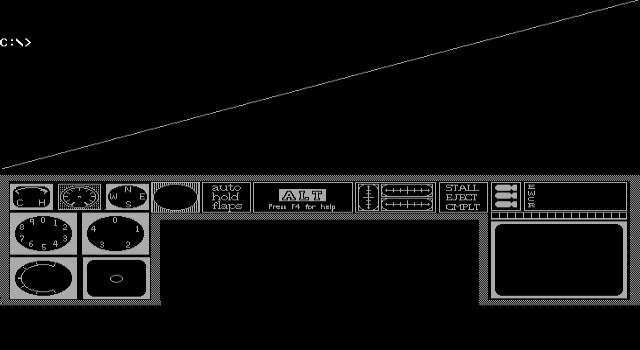
Draws the compressed IMG/3D*.IMG cockpit and help graphics into EGA video memory. It explicitly requires BIOS mode 10h. Native helper capture. |
TOWER.EXE |
Tower/intelligence screen helper. Reads TOWERS.DAT and references STARTLOC.DAT; handles the mission-information/start-location interface. |
ISCORE.EXE |
Score/report display helper. Reads shared MOAG.CFG state and contains pilot, current score, total score and high-score display labels. Presence of the helper does not prove every edition exposes every reporting option. |
SRATS.EXE |
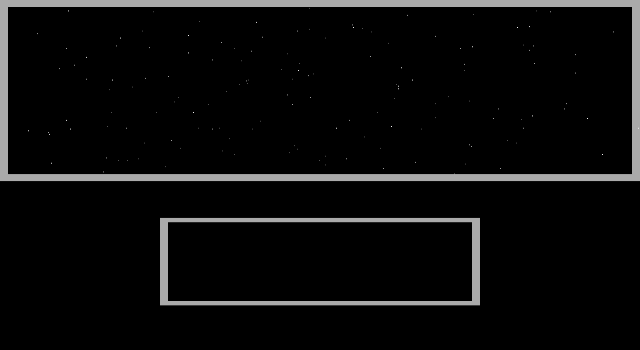
Standalone starfield/effect animation, also requiring BIOS mode 10h. Invoked by the flight engine. It supplies the experimental-aircraft ascent and Earth-saved ending. Native helper capture. |
SOADL.EXE |
Small AdLib sound-effect helper/driver, with 3.ADL as its register-definition file. Separate from the larger music driver in MOAGDATA. |
JVCC.EXE |
First-run JPEG converter. Its own usage text says it converts 256-colour JFIF/JPEG files into VGA files suitable for 256PAINT. The manual credits the Independent JPEG Group. |
The batch flow is explicit:
MOAG -_-       → menus and preparation
3 -s           → flight/gameplay
MOAG -_- -r    → return to menus and process the result
               → repeat
Exit status exactly 137 from the menu ends the batch loop. Other helper programs are launched from inside the executable code. This is a collection of cooperating DOS programs rather than one executable containing every screen.
Direct launches are possible with the appropriate arguments or graphics context; see the verified commands and launch tests.
Theatre definitions: DEF/
Each normal theatre has a binary world definition and readable tower/briefing text:
| Files | Contents |
|---|---|
MORNING.CCT, MORNING.TWR |
Atkinsville (easy), the dawn theatre. The text includes Insult to Injury, Unlucky Ufo, Baka Bomb and Heart of +. |
WASTELND.CCT, WASTELND.TWR |
Wasteland (medium), described as the devastated remains of Virginia. Mission text starts with Cuckoo's Nest. |
DUSK.CCT, DUSK.TWR |
Dusk (medium), with missions requiring precise flying. First briefing: Thread of death. |
WHTSANDS.CCT, WHTSANDS.TWR |
White Sands Testing Ground, practice targets and the experimental aircraft/high-altitude assignment. |
DEFTOWER.TWR |
Short default/empty tower-description template. |
The .CCT files contain binary world/object state; their records are fully decoded in the format notes. The .TWR files are ordinary text, including theatre descriptions, mission briefings and starting-coordinate directives such as Sxyth .... These texts already expose quite a lot of the mission design without disassembling the engine.
Cockpit and help graphics: IMG/
The eleven files are 3D.IMG, 3D2.IMG through 3D10.IMG, and 3D13.IMG.
They are compact run-length encoded screen masks used by RIMG.EXE, not floppy images or 3D model files. The helper expands repeated and literal byte runs into EGA video memory. Running it in a private mode-10h DOSBox session draws the cockpit, instruments and view-frame linework. 3D.IMG is the cockpit instrument panel, including the diagonal line already present in the source. The numbered images are help pages, not other cockpits: takeoff, instruments, controls, warnings and on-foot play. See the checked help-screen transcriptions, including the earlier editions' longer wording and first-run welcome page.
VGA artwork and palettes: VGA/
There are 26 image files and three palettes. Most outcome/story illustrations began as JPEG files and were expanded by JVCC.EXE on first launch. Title pieces and sprites were supplied directly as VGA files. These are the game's 2D artwork, not its in-flight polygon models.
| Files | Use or identified subject |
|---|---|
TLOGOGR.VGA, BLOGOGR.VGA |
Two logo components referenced by the title program. |
HC6NEW.VGA, TCLOUD5S.VGA, FLASH.VGA, TNAMBC.VGA |
Additional title-sequence artwork and effect pieces; all are explicitly loaded by CCTITLE.EXE. |
SSFLAK1.VGA, SSFLAK2.VGA, SSFLAK3.VGA |
Three flak/AA sprite pieces used by the title animation. |
SKLA1.VGA through SKLA4.VGA |
Four KLA sprite pieces used by the title animation. |
CAR5CJ.VGA |
Introductory peaceful-1938 story panel. |
CAP1CJ.VGA |
Introductory alien-attack story panel. |
PCORS3A.VGA |
Safe return/landing at the airstrip. |
RV4A.VGA |
Rescue-squad pickup. |
CRSH2A.VGA |
Crash landing; different captions cover recoverable and unrecoverable aircraft. |
EXPL4A.VGA |
Fatal impact/explosion. |
FLYBY2.VGA |
Return after too many flybys and a poor landing. |
PRISBAR4.VGA |
Stockade outcome for destroying friendly forces. |
CORP2BS.VGA |
Dead-pilot illustration shared by falling, shell-fragment, KLA, crater and other fatal outcomes. |
TOILET2A.VGA |
Capture and a lifetime of cleaning alien toilets. |
S_DRUNK1.VGA, S_DRUNK2.VGA |
Drunken/missing-pilot artwork. PICT.DAT explicitly uses the second for being found in a local establishment without knowing where the aircraft went. |
SEARTHJ.VGA |
Saving Earth/victory illustration. |
SKY.PAL, GRADSKY.PAL, HC6.PAL |
Three 768-byte RGB palette tables associated with the title artwork. |
The subject mappings above mostly come directly from the image filenames and captions in PICT.DAT and TPICT.DAT. The four less descriptive title filenames are deliberately left with their confirmed title-program role rather than guessed visual subjects.
Presentation, help and font data
| File | Contents |
|---|---|
PICT.DAT |
Readable outcome/presentation script, with 15 form-feed-separated entries. Specifies image filenames, numeric layout/style parameters and captions. Several outcomes share one illustration. |
TPICT.DAT |
Two opening story panels: peaceful August 1938, then the invasion and eleven years of resistance. Contains image references, text and placement/colour fields; these numbers are not caption timings. |
MOAG.INF |
Context-sensitive menu help and promotional pages. Uses form feeds and inline formatting/hotkey markup. It also retains sections labelled OLD/NEW SHAREWARE VERSION. |
MEDAL.FNC |
Sixteen custom text-mode glyph records, 17 bytes each: sixteen bitmap bytes plus a character code. Used for medals/insignia in the text interface. The loader checks that its size is a multiple of 17. |
Music and sound data
| File | Contents |
|---|---|
DESTINY3.ROL |
AdLib Visual Composer music sequence explicitly referenced by the title program. |
RIDINGT.ROL, DREAMSO2.ROL |
Other AdLib music sequences. Both are listed in the menu playlist. |
ROLFILES.TXT |
Plain-text playlist containing ridingt.rol and dreamso2.rol. |
CCMUSIC.BNK |
AdLib instrument bank used to give the ROL note/event sequences their instrument sounds. |
3.ADL |
Twelve text blocks of hexadecimal AdLib register/value definitions for the sound-effect system, separated by ff lines. Playable auditions and native sound examples are described in audio-rendering.md. |
MOAGDATA |
Bundled AdLib music-driver code, obfuscated by XOR with 0xA5. MOAG.EXE contains the decoding loop and temporary DRVR.EXE filename. Decoded data includes the SOUND-DRIVER-AD-LIB signature and Ad Lib Inc. driver V1.51 identification. It is not a general resource pack. |
The actual XOR instruction is at MOAG.EXE file offset 0x1b823. The music file types are recognisable standard AdLib formats; the in-flight effects use their separate register-definition system.
Configuration and generated state (initial snapshot)
These five files were created after the original extraction:
| File/directory | Purpose/current state |
|---|---|
3.CMD |
Menu-to-flight argument file. Currently contains -w3, -l5, -m2, -n6 and -iy{k. These are game options, not shell commands. |
3D.CFG |
Flight-side configuration file. Empty in this inspected state. |
MOAG.CFG |
Binary shared/menu-session state; also read by the score helper. Currently 1,580 bytes. |
PILOT.HSC |
Persistent high-score tables. Currently 5,040 bytes and all zero. This is separate from the named-pilot record file PILOT.SCR seen in your old install. |
TOWERS.DAT |
Generated current briefing/intelligence text. Presently describes a training scenario with a flying saucer, missile/AAA/vehicle sites and fuel dumps. |
THT/ |
Empty directory, ready for per-pilot saved theatre files. Later saved .THT files are now decoded in the map browser, including their embedded pilot/statistics record; see state-formats.md. |
The program also refers to transient files such as 3UNIV.DAT and STARTLOC.DAT, and creates PILOT.SCR when needed for named-pilot state. They were absent in that snapshot; later STARTLOC.DAT and pilot/theatre saves have been inspected. The initial inventory is retained as a historical extraction record.
Documentation and the boss screen
| File | Purpose |
|---|---|
CORNCOB.DOC |
Main manual: controls, flight, on-foot play, weapons, enemy types, progression and credits. Plain text despite the .DOC extension. |
ORDER.FRM |
Printable $20 Other Worlds Campaign order form, with hardware/game-preference questions. |
BOSS.TXT |
F1 boss-screen text: mostly blank lines followed by a fake C:\> prompt. The manual explicitly invites editing it. |
The manual also directly identifies the implementation as assembler and C, credits Kevin Stokes and additional programming by George Welch, names the Spontaneous Assembly library, and credits the Independent JPEG Group. Those are contemporary primary-source development clues rather than deductions from executable signatures.